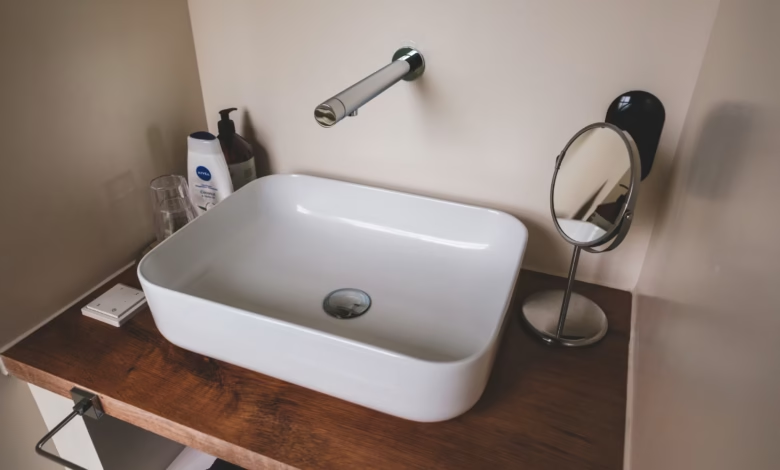
Wash basins, bathroom sinks as they are also called, are the bowls which hold water for washing hands and face. A faucet fills the bowl with clean water. A drain lets dirty water go away in a safe way. Most of the basins have a small hole nearby called an overflow. This is for avoiding accidents of spilling. Under the basin is a curved pipe, which is called a P-trap. The P-trap holds a little water to block bad smells from the sewer.
What a Wash Basin Does
The wash basin makes handwashing easier, cleaner, and safer. It is not as big as a kitchen sink, so it is intended for the minor daily activities such as brush teeth, wash hands, and freshen up. The basins come in different shapes and sizes, some of them can be free-standing, while others can be hung on a wall or placed on a piece of furniture called a vanity.
Common Types of Wash Basin
Pedestal Basin
This kind of Wash Basin is the one with a bowl on top and a stand that is a tall one under it. It is the pipes, which could be made to disappear with the stand. This is the evergreen classic, which is a perfect match for small bathrooms. It doesn’t give the convenience of storage either above or below.
Wall-Hung Basin
This sink adheres to the wall by means of a special bolt and is not built on legs. The floor under it is open, therefore it can be easily cleaned. It is space-saving and can be adapted to a comfortable height. The stability of the wall is an important condition; so accessorizing any visual intrusions that end up hiding those pipes may be needed.
Countertop or Vessel Basin
This sink needs a countertop or a vanity for its placing. It can be square or round in shape and may come in different materials such as ceramic, glass, stone, and others, but the installation of a taller faucet or a wall faucet is necessary. The base should be properly locked so that no leaks form.
Undermount Basin
This sink hung from the lower end of the counter. The rim is covered by the edge of the ledge so that the water wiping action from the counter straight on into the bowl can be easy. It can work very well with solid counters like stone or solid-surface, however, it does need a strong support.
Drop-In (Inset) Basin
By cutting a hole in the countertop the sink drops down and rests on the rim. This is the simple way of adjusting it alongside many vanities and its fit can be done by any average person. The rim should be taken care of with weather stripping to ensure that no water is seeping under it.
Corner and Double Basins
A corner basin is there for places where space is a tight fit, like a tiny powder room. A double basin has two bowls placed on one long counter and works best in crowded bathrooms.
Materials: What Sinks Are Made Of
Ceramic, Porcelain, and Vitreous China
Most wash-basins are from these. They are the sinks that are made of clay which was fired in a fire on high light and then cc cud on top of the wet poit so we very shiny and hard were the glaze to fire on them The glaze is being used for the rest of the areas. This is a plain and easy to maintain way, and the sinks can last long and look great.
Stainless Steel
It has been constructed of steel metal that is quite strong and at the same time, it is lightweight and is resistant to rusting. It is used more in working rooms and public places than in homes. It has a weak point of scratching and showing water spots, but the advantage is that its cleaning procedure is a snap. Just by using soap and water without going through a long laborious process it cleans well.
Glass
On the other hand, it is quite easy to remove the scratches and mundane presentation is out of the question. The glass is a material that, when treated in the correct manner, can be very resistant and, at the same time, is friendly to the human’s activities and is the best solution for their needs.
Natural Stone
Granite, marble, onyx, and other stones have the magic of texture, the beautiful colors, and the natural patterns that bring elegance and beauty to washrooms. Also, they are very heavy and one can find out the cost to finance such stone. In addition to the above-mentioned stone types, those that are not able to imply in the stone types need to be consequentlyhill.
Solid-Surface and Composites
These materials are called by the name solid surfaces, and they mean that they are man-made blanks poured into the mold. Many of the colors are available, and the users will have the chance to make a few scratches which will easily be repaired. This is a characteristic of the surfaces that are not porous and are smooth to the approach. However, too hot items might be knocked with the mark.
Cast Iron with Enamel
Cast iron Wash Basin can usually be seen with hard enamel surfaces made of fine particles of iron. On top of that, a classic shiny appearance can be observed on the outside of the basin. It is a really heavy basin and needs a special supportive base. In case a nay part of the surface becomes visible owing to the chipped shell the rest of the shell is most likely to be rust-colored after a while.
Other Materials
Even materials like copper, brass, and concrete, even aluminum will be of the surprising appearance of the counter basin, in particular those that are covered with sealants which are safe for the wooden models.
Sizes and Heights
Most washbasins are quite big in size and are in the range of about 15 – 26 inches, depending on the size of the bathroom. Often they are 12-24 inches front to back as well. Normally, the depth of a bowl is about 5-8 inches.
No matter how many basins some people decide on, they don’t have to worry because they are templates compared to the one that’s “adultized” which is about 32-34 inches. Activating a WC must be with a height of 34 inches, allow downstairs space and no protruding designs.
How Water Flows and Basic Set-Up
- Drain and P-Trap: The sewer drain removes wastewater. The P-trap water holds to stop sewer gas. The scale of a stairway is 11/4 inches to the length of a fraction inches. Trap and vent connections must be within distance code as per the municipal code.
- Water Supply: Faucet connection to hot and cold is facilitated with a flexible hose. The water supply can start and stop using the small shutoff valves lurked under the sink while the technician is still conducting repairs.
- Seals and Gaskets: Either plumber’s putty or silicone caulk is to be used for the sink drain as well as the edges of the top to make the sealing effective.
- Mounting Basics: Thus, it’s either solidly built studs or a metal carrier that will be needed for wall sinks At the same time, of course, the fastening is a matter of bolting up pedestal bowls so that the wall can help to carry the stand.
- Safety: Water destructors in the underside tunnel the water and alter it to 110°F to stop the human skin from burns. After turning the water supply, you must check for any leakage from the joints.
Rules and Standards in Simple Words
- Accessibility: The water Wash Basin purposes of many places which remain at most 34 inches high are as of the most and the best. It is a necessity to leave at least 27 inches of free standing area under the sink for a wheelchair to go through it. Faucets that are touchless or ones with handles which people can operate with one hand are good choices for the disabled.
- Plumbing Codes: The traps should not be P-traps or worn out. According to the code, the elbow on the pipe has to be in an 188th position from the wall.
- Product Tests: Among UK and EU, BS EN 14688 grants their approval on virtual core strength and overflow performance. Their similarity is given in the quality and testing standards.
- Clearance: In cases we are exhibiting the LJL^ATH for the purpose of the age of pre-lithographic techniques, the code of customer chat for it recommended not less 15 inches from drain the center of Sink to the hit a ba# cervix to give ion^ el#w room.
Prices: What to Expect
Ceramic or porcelain sinks are the most affordable, ranging from about $100 to $300. Glass and stone vessels can be found at prices between $200 and $800. Man-made composites such as solid-surface and solid-surfacing are typically charged between $200 and $600. The pedestal basin set can be quite a bit more, running you a price of between $200 and $500. It is not unusual to spend more than $1,000 on material such as stone and copper.
New Trends and Ideas
- Water Saving: Single-lever and sensor faucets with WaterSense that give out a lesser amount of water are water-saving devices that can also save between 20 and 30 percent of your annual water bill.
- Touchless Use: The sensor faucet allows people to turn the water on and off without touching it so that they are not taking unnecessary risks in terms of hygiene and at the same time cutting down on water usage.
- Antimicrobial Touch Points: The good news is that copper and brass are very effective substances that are capable of collecting microbial particles. There are also some other protective glazes that can add antifungal agents.
- Green Materials: Changing the purchase to a one-off is possible. Fruits-, glass-recycled, tops that are durable, and those which have the ability to be recycled are materials, the properties of which are provided by the company.
- Modern Looks: The items that are mostly found in the Clean, lean, muted colors, and wall sinks are amongst the most sought choices in the renovation of bathrooms.
- Small-Space Solutions: The solutions to smaller bathrooms could be emitting corner sinks, narrow basins, or sinks that have been constructed using rails or small alcoves.
Care, Cleaning, and Simple Fixes
Daily Cleaning
A mild soap with a soft cloth will do the trick to the dream of the kitchen. No scratchy pads should be attempted ”Zoe addresses Alana directly. She remarks on the kitchen sink’s efficacy. Make sure to choose the glossy finish ones for the type of application you intend for. For glass do not use vinegar. For marble using vinegar is great to facilitate the cleaning with some water.
Hard Water Marks
The soft cloth soaked with a small quantity of vinegar will bring light steel, porcelain formulants, and shapes to look like never before on the final surface. Please never use vinegar on natural stone as it can cause damage.
Clogs
Hair and soap can make your drains clogged availability. You can use a small plunger or remove and clean the trap using a bucket under while the repairs are made. The wallpaper and paints in those areas should not be weakly chemically influenced, as this would harm the pipes and surfaces. Instead, regular contact with the surface is the only option
Leaks
Neatly but not too strongly tighten loose nuts. Replace worn washers or faucet cartridges if drips continue. The seal around the drain flange might need to be re-coated, we suggest.
Chips and Stains
Clean spills as soon as you can. Tough-up kits can be your solution for the little chips found on the enamel or porcelain. Scuff marks and chips are made clean throughout the bathroom area where these items are located as a result of their utilization.
How to Choose the Right Wash Basin
Smaller-sized bathrooms can use less floor space when a wall-hung, corner, or skinny pedestal sink is placed in them. A big counter-mounted undermount sink or a wall mount double sink/ bathroom vanity unit makes the best spaces a lot easier to share.
- Kids’ bathrooms: A colorful porcelain basin at a lower height is the best solution.
- Public or Heavy Use: You are looking at wall-hung or composite benchtops with sensor faucets that suit outdoors and high traffic areas respectively.
- Budget: There are three scopes you can consider. Basic drop-in ceramic is the lowest, and one can get them at around $100 or a piece. Solid-surface or designer glass sinks lie in the middle of the $200 – $500 range. The highest end being premium materials made of solid natural stone or copper of $1000 or more. Solid surface sinks are likely to be the most expensive because of the type of materials involved.
- Appearance Consistency: Checking cabinet depth, door swing, space to nearby fixtures, and specifically, deck hole position make sure that the chosen faucet goes with the sink. Ask the cabinet suppliers about the specific dimensions and the possibility of any adjustments.
Conclusion
The best sink to choose is the one that not only saves up space on the floor area, thanks to its sleek design suited to the size of the room, but it also harmonizes the aesthetics and economy, something pertinent to the budget and style you succeed in. However, too hot items might be knocked with the mark. Clean carefully for things which don’t have to be thrown away. Track the wells to spot small leaks and install the proper narrow pipe underneath. The selection of what materials to use and what and how to undertake the procedure will minimize the loss of sink as well as give a new appearance multiyear of using the product.