Wondering how to make a room look bigger? Having a small room may result in a feeling of claustrophobia and not being able to relax comfortably. However, some things can be done without having to engage in complex (and expensive) processes like structural alterations to rooms. The ideas I got here, tricks and tips, basically are about fooling the eye to see some of the spaces getting bigger than they really are.
Understanding How Eyes See Space
The brain looks at a room, and almost immediately, it decides whether it is small or big. When you have good sight, you can see more sunlight and moonlight from outside. Moreover, the room will look spacious because the floor below will seem to be open space.
The thing here is to permit a free and uninterrupted movement of the eyes within the room and thus create a feeling of more space.
How to Make a Room Look Bigger with Paint
Light Colors Reflect More Light
Light colors are an effortless way to make the rooms appear larger. White, light cream, and light gray colors reflect bright sunlight over the room thus catching the idea of a large area even if there is no space. They give the ability to nearly feel the garden and the sky, even though there is no city nearby.
Here are some paint colors that would be a good fit for a small room in a home:
- Pure white or off-white
- Soft ivory shades
- Very pale gray
- Pale blue or green
With Paint Colors
How to Make a Room Look Bigger with Paint Colors? When you are at the shop, you should only go for the shades that reflect well, but they should all reflect light. It is a good idea to apply the light colors to the sidewalls and the ceiling. The ceiling, which is like a plane separating the space from the earth, should be painted white or a bit lighter than the walls.
Instead of having trim ridges breaking up the space, which gives a large application to only one section yet breaks up the rest, using the same color on all walls, and the ceiling does the trick. Therefore, the eye has no distinction on where the wall connects to the ceiling and rests on the fact that a wall is definitely there.
With Dark Paint
Sometimes the use of dark colors is not always a bad idea. But many of you still looking for how to make a room look bigger with dark paint? Sometimes, dark paint eliminates the vision of walls, and the room seems empty. This method is ideal when you are trying to have the walls act just as a backdrop for the furniture and the floor area that you have.
Usually, wall dark colors fade into the picture, and the rest of the house furniture gains importance based on that. The use of apparent color is a simple way of making the eye focus on a particular area in the room, the center of the room in my example.
With Accent Wall
How to make a room look bigger with accent wall? An accent wall is one wall that is painted with a bold color, while the other walls are painted a light. As far as where to place the wall, it is better to have it as far away from the main entrance as possible. This effect allows for the focus to be drawn deep into different spaces, and the room will be elongated visually.
Hope the walls are better chosen – so, use a rich color like dark blue, olive green, or charcoal gray for the contrasting accent wall. As soon as you install the accent wall, make sure the other three walls are in pastel colors, except the deep one on the accent wall.
How to Make a Room Look Bigger Without Painting
Use Mirrors to Double the Space
Mirrors are nothing less than magic for small apartments. They create an illusion of a big room by reflecting natural light and the scenery in and then out of the room. A mirror that is huge with a window on the wall opposite to it will get you the impression of being outdoors.
Since the ceiling is the highest point in the room, leaning the mirror vertically next to the wall will add a sense of spaciousness to the room. They work in groups since they cast perfect images, which is the reflection of light, which it then reflects off for a better feeling.
Choose the Right Furniture
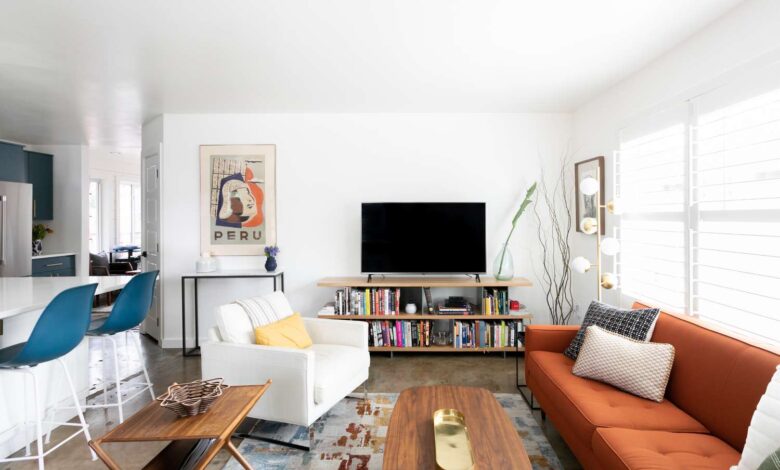
When a piece of furniture has legs, there is more visible floor space because it is easy to see through the top layer and gain a panoramic view of the room. No furniture lying on the ground is also a factor (openness).
Moreover, anything made of glass barely has a visual effect when integrating but extends its use. Tables and chairs transparent by design not only retain function without impeding your visibility across the room but also provide function without cutting the room into smaller parts (sometimes that used up space may even be three or four times bigger than even the biggest table).
Let in More Light
Take away thick curtains in favor of lighter fabrics that are see-through. Make sure to hang the curtain rails close to the ceiling so that they expand past the window edges. This way, you make you window look larger.
Dark corners are illuminated with the help of additional lamps. The light angling to the corner also helps to create a feeling as if that corner of the room is big enough.
How to Make a Room Look Bigger on a Budget
There are designs that can dramatically and cheaply help to make a space appear to be bigger:
- Choose a color for both your walls and ceiling that is light, tranquil, and warm.
- Keep all the vertical surfaces free of objects.
- Avoid the wall remnants and the center the sofa as nearly as you can.
- Ensure that you only have one big rug, instead of multiple smaller ones.
- Bring in a standing lamp, so no surfaces are taken on by the required lights.
- You should attach higher images on the wall in the buying more stuff situation.
Smart Shopping for Small Spaces
In the process of buying new, versatile furniture is one that can be utilized for different situations. For example, ottomans can serve as extra seats and also hold some items within their storage space. Space-saving collections such as nesting tables consist of furniture that folds out when extra space is needed and then can be hidden away when not in use.
Do yourself a favor and focus on buying larger items rather than buying a lot of small ones. It is more effective for the room to appear bigger by also having the same number of furniture items in bigger but one than with many small units. As a result of this, you also have less one-piece furniture which also takes less space.
How to Make a Room Look Bigger with Wall Art
The wall arts are among the elements that which don’t let a small area breathe. The only way you can control such a situation is to have a more substantial image. This is the idea behind of making a wall look more alive with a big painting or a clear picture.
Pick a single piece of artwork, preferably one with depth. Paintings of landscapes are perfect for this. These create a real view on the wall, rather than projecting on to it. These methods help to create a unified and vertical flow that makes the pattern more visually interesting and makes the ceiling seem higher.
Having art pieces at the level of the eyes – in this case 57 inches from the floor to the mid-center of the piece, does also contribute to the ceiling looking higher and the whole decor is set in a better flow.
Decorating Rules That Help Small Spaces
The 3-5-7 Rule of Decorating
3-5-7 is a common standard used by designers to maintain visual clarity without being hyperoccupied and dull. Choose odd groupings as they look more natural and dynamic than even numbered ones. The number of items to group is 3, 5, 7.
- 3 big things: the sofa, the table or/and the rug.
- 5 medium-sized items such as a chandelier, plants, etc.
- 7 small things like candles and decor.
This way every object is seen separately more or less, and the room stays personal yet does not get a clutter. The rule is retained further even if items placed inside do change.
The 60-30-10 Rule for Bedrooms
A simple way of determining the color to use is to follow a 60:30:10 rule in home coloring. Put three colors to the mix and count how many of them each of the three has in their color they each comprise:
- The base color: 60% of the space (walls, bed, etc.)
- The secondary color: 30% of the total area – it is featured in the draperies, throw rugs, bedding, and the smaller furniture items
- Accent: hitting 10% means that the smaller parts like pillows, images, etc. could be a couple of items only
For small rooms light and bright make up 60% of the wall greenspace and this turns out as the main color.
Common Mistakes to Avoid
Of course, some design decisions can stand in the way of solving the problems of small rooms.
- Many colors
- Window treatments that are generally very low are to be replaced with those placed at the top of the window opening, to cover up half the wall.
- Pushing all the furniture against the walls, pristine, especially the largest item of your room.
- Choosing a small room over big things, buying every stylish accessory and house without concern for space.
- Thick curtain panels are often the cause of the room having very little light.
Be aware that a centrally located piece of furniture (sofa or tables) does not create a dead area underneath it.
Final Tips for Success
Big rooms are different. It needs carefulness to plan and execute. Just some advice: tranquility and less décor can be the best. A good space should have a sense of knowing where and still provide a fresh view. Stick to fewer items, but choose meaningful ones. You can make a little room a luxurious and comfortable place by getting creative and incorporating these simple methods.
Frequently Asked Questions
How do you make a room look bigger?
Instead of ñmonotonousî (all the colors have been chosen dark) one the wall was covered with pale teal, for instance, and another was green. These are the three colors of the walls. The main one on 60% of the space that comes from the ceiling, solid-colored rugs, or as linen; flowed curtains in medium greenish or denim colors break up the fresh clean backdrop and kaki orange pillows scattered along this armchair. These essentials are essentially the greening of the walls *>.
What is the 3-5-7 rule of decorating?
The 3-5-7 rule is used by decorators to keep the visual content clear and acceptable while not covering (spiritual) the room with stuff. Why is it good to give one single element space? It is interesting because its function becomes much more sympathetic and in accordance with an item of related function as a sofa, rug, and table.
What is the 60-30-10 rule for bedrooms?
The 60-30-10 rule is simply a formula of dividing the color palette into the aforementioned proportions, creating a balanced composition. The usage of only a few necessary items adds to the feeling of airiness. The room may function much better if some of the problems are worked out and things are done differently.
What are some cheap ways to enlarge a room?
If you would like to increase the visual space of the room, then you should use the soft and light colors as wall paint. Experiment with your space, removing clutter, repositioning furniture or adding inexpensive mirrors can be enough to make your room look much bigger. Also lighten it up with sheer panels, match your ceilings, and curtain panels.