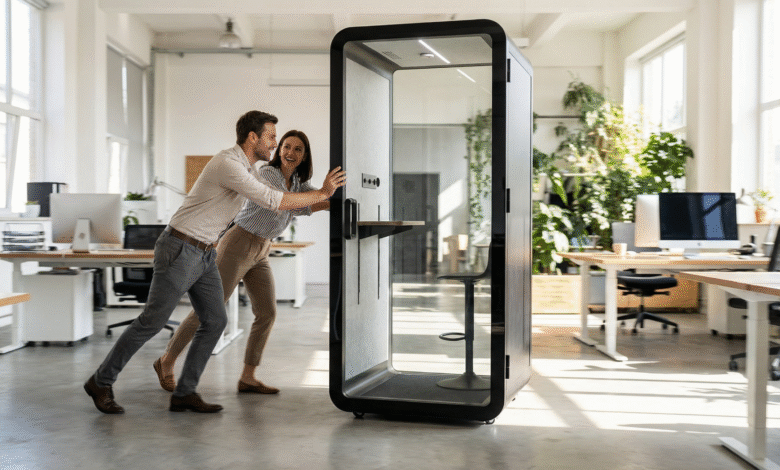
Open-plan offices solved one problem and created another. Collaboration got easier, but focused, private work became harder to find. A conversation two desks away, a phone call across the room, or a constant stream of foot traffic can turn a simple task into a drawn-out one.
That’s the gap a personal office pod fills. It’s a self-contained space within a larger office, built for one person to focus, take a call, or work without interruption, without requiring a dedicated room or major construction.
Why Personal Pods Have Become Standard in Modern Offices
Office layouts have shifted toward openness for years, driven by collaboration goals and real estate efficiency. But that same openness makes concentrated, heads-down work genuinely difficult. Noise travels, visual distractions multiply, and confidential calls become awkward to take at a shared desk.
A personal office pod addresses this directly. Rather than redesigning an entire floor plan, companies can drop a pod into an existing layout and immediately create a private zone. Office managers and facilities teams have leaned into this approach because it’s faster and considerably less disruptive than a full renovation.
Procurement teams furnishing new offices increasingly budget for a mix of open desks and enclosed pods, recognizing that one layout style rarely suits every task or every employee.
Key Benefits
Instant private workspace. No construction required. A pod can be placed and functional within a day of delivery.
Reduced noise distraction. Sound-dampening panels meaningfully cut down on ambient office noise, both entering and leaving the pod.
Flexible office layouts. Pods can be repositioned as office needs change, unlike permanent walls or built-out rooms.
Better use of existing floor space. Rather than sacrificing an entire room for private work, a pod uses a fraction of the footprint.
Buying Guide: What to Look For
Not every pod on the market delivers the same value. Here’s what matters most when comparing options.
| Feature | Why It Matters |
| Acoustic rating | Look for a specific sound reduction figure rather than general soundproofing claims |
| Interior dimensions | Confirm there’s a comfortable room for a desk, chair, and basic movement |
| Ventilation | Active airflow prevents the pod from feeling stuffy during extended use |
| Assembly requirements | Some pods need professional installation, which affects total cost and timeline |
| Material durability | Engineered panels with proper sealing outperform thin composite alternatives over time |
| Electrical access | Built-in outlets and lighting simplify setup significantly |
| Warranty terms | A solid warranty period is a reasonable signal of build confidence |
If you’re outfitting multiple pods across an office, ask about volume pricing and consistent lead times, since procurement timelines often hinge on that more than the spec sheet alone.
Common Mistakes to Avoid
Underestimating interior space needs. A pod that looks adequate in photos can feel cramped once a desk, chair, and monitor are actually inside.
Ignoring ventilation quality. Poor airflow makes even a well-insulated pod uncomfortable during longer work sessions.
Choosing based on price alone. A cheaper pod with thin panels often underperforms acoustically, which defeats the purpose of buying one in the first place.
Overlooking assembly logistics. Some pods require more setup time and labor than advertised, especially for multi-unit office installations.
Expert Tips for Getting the Most from a Pod
Place pods away from high-traffic walkways when possible. Even a well-built pod benefits from a slightly quieter placement within the office.
Ask for the specific acoustic rating before purchasing rather than relying on general marketing language about soundproofing.
If outfitting several pods at once, request samples or a showroom visit first. What looks right in a catalog doesn’t always match the actual footprint needs of your team.
Featured Category: Personal Office Pods
For businesses comparing options directly, Meet&Co’s personal office pod category includes several models suited to different office layouts, from compact single-person booths to slightly larger configurations with extra desk space. These units are built with practical acoustic performance and ventilation in mind, without unnecessary premium features that drive up cost.
It’s a reasonable starting point for facilities teams trying to balance budget against the acoustic performance an open office actually needs.
Why Choose Meet&Co
Meet&Co Office Furniture Factory manufactures a broad range of workspace solutions, from personal office pods to complete office furniture systems. The focus stays on practical engineering and consistent build quality across order sizes, whether a business needs a single pod or a full floor’s worth.
Meet&Co also produces furniture well beyond office pods, including a student desk and chair set for classroom environments, which reflects a manufacturing range built for institutional and commercial buyers alike. That range matters for procurement teams and distributors who prefer sourcing multiple furniture categories from a single, reliable factory rather than juggling separate suppliers.
FAQs
How much space does a personal office pod need? Most single-person pods require roughly 3×3 feet of floor space, plus clearance for the door to open fully.
Are personal office pods actually soundproof? Most pods significantly reduce noise but aren’t completely soundproof. Ask for a specific acoustic rating rather than relying on general claims.
Can a personal office pod be moved once installed? Many pods are modular and can be relocated, though this varies by design. It’s worth confirming before purchase if flexibility matters.
Do personal office pods require electrical wiring? Some include built-in outlets and lighting, which typically need a nearby power source rather than dedicated wiring work.
How long does it take to assemble a personal office pod? This varies by model, but most single-person pods can be assembled within a day, sometimes with two people.
Are personal office pods suitable for coworking spaces? Yes, they’re commonly used in coworking environments to offer private workspace without permanent construction.
What’s the difference between a personal pod and a larger meeting pod? Personal pods are designed for one occupant, while meeting pods are sized for small group discussions and typically have more floor space.
Conclusion
Choosing the right personal office pod comes down to matching acoustic performance, interior space, and ventilation to how your team actually works. A pod that’s genuinely built for daily use pays off in fewer distractions and better focus, day after day.