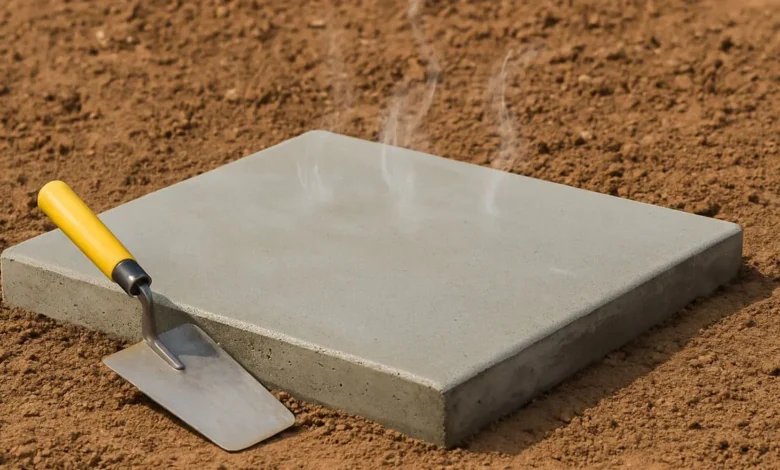
Still wondering how long does concrete take to dry? First things first, let me explain the process of concrete drying so that we can be on the same page. The components that go into the concrete are cement, water, sand, and tiny rock particles. When the water from the cement mixes with it, a special chemical process called “curing” starts. Curing is not the same as drying, though.
You might have come across the question of why concrete gets so hard when water evaporates. It is because the water strengthens the concrete and thereby makes it a better building material. The water is not merely getting exhausted. Instead, it bonds with the concrete, finally making it tough and solid.
A lot of people may think that concrete dries in the same way as wet clothes that are hung outside to dry in the sun. However, this is not the case as concrete actually uses water to bond and become solid. This is exactly why many homeowners ask how long does concrete take to dry before they can walk or drive on it.
Basic Timeline for Concrete Drying

First 24 Hours
To understand how long does concrete take to dry, you need to look at the curing timeline of concrete. At the end of the first day, the surface of the concrete becomes quite firm and starts to solidify. After the first 24 hours, if it is not too thick, you can normally walk on a concrete surface. But remember, it is still very weak inside.
During this period, concrete appears dry from the outside, but in reality, it is not solid throughout its depth. So, however tempting it may be, don’t load it too much yet. The worst thing that can happen is the bike leaving marks or even cracks.
First Week (7 Days)
At this stage, many people start to understand how long does concrete take to dry for normal use. One week later, the concrete becomes stronger and is now almost 70% hard. This means you can safely walk on it and put light furniture on it.
For many laypersons, a week is thought to be the time when concrete is finally set. However, that’s not true because concrete only gains its full strength over time. It becomes hard enough to be stressed by light things, but it is still not fully ready for the movement of heavy equipment.
One Month (28 Days)
At 28 days, the concrete is at approximately 95% of its eventual strength. This is the time when people generally consider it fully “cured,” hence the usage of it. One can park cars on it, bring heavy stuff, and treat it like they normally would.
It is usually the endurance of the workers who have to leave the support pieces for even this long and do tough jobs on concrete structures. This length of time to wait, stated, is a protector.
Full Strength (Several Months)
Concrete actually keeps getting stronger over many months and even years. In some cases, after a year, 10-15% growth might be seen as compared to the 28th day. The majority of the users demand only the 28 days.
What Makes Concrete Dry Faster or Slower?

Weather Conditions
Under dry sunlight, the exterior of the concrete will dry at a high rate, but the interior might be left vulnerable. Sometimes, the interior is still soft even when the exterior looks hard.
Cold temperatures slow down everything. The curing process almost stops when the temperature goes below freezing (32°F or 0°C). The water inside can freeze and harm the concrete, which won’t be recoverable.
In a humid climate (when the air has the maximum amount of water), the concrete actually cures better. The concrete does not lose water quickly, which makes it last longer.
The wind might blow the water within the concrete away, making the surface so dry that even cracks might appear.
Thickness of Concrete
A sidewalk, which is a thin layer of concrete, dries faster than a thick foundation. This is the result of water being able to escape more easily from the thin layer.
Consequently, a sidewalk that is 4 inches thick can be walked on 12-24 hours later, while a foundation that is 12 inches in thickness may require 2-3 days before it is safe to walk on.
Type of Cement Used
Each type of cement has its own curing time. Often, regular Portland cement is used, and it takes the same amount of time as we mentioned before.
This type of cement is a fast form of cement that can be ready to be stepped on in just 2-4 hours. The cost is higher, but the labor is quite hard because of the quick hardening.
Certain types of cements are made that are better in cold weather, and they cure when out in the chill.
Amount of Water Mixed In
The extra water makes the concrete smoother, easier to pour and distribute, but also weaker and longer to cure. The lesser water makes stronger and faster-curing concrete, but it is harder to manage.
Different Types of Concrete Projects
Driveways
A driveway made of concrete must be strong enough to carry a car because cars are heavy. Driveways, most with driveways, allow driving on them after the first 7 days, probably. For the best, optimal results, take 28 days as a standard period.
Driveways could hence be walked on after 24-48 hours at the earliest. However, don’t dare to park cars, trucks, and motorcycles on them unless the entire structure is firm enough.
Sidewalks and Walkways
Sidewalks are not as strong as driveways because not as many cars are moved along them as they are nobody’s light. Nearly all sidewalks can be used after 24 hours.
While you can trek over the sidewalk in a day, try to resist sprinting, jumping, or putting heavy stuff onto it after a week of its installation.
Foundations
House foundations are generally very thick and can be expected to hold a heavy load. But most foundations will still need that curing time before the builders can go and put up the walls.
It might be that the ground also needs more time to cure in certain types of foundations, which are deep ones, inside the earth, as compared to the shorter layers found above the ground. So the outside pops out-it-more-md-3pWz4TcQ in one month.
Patios and Outdoor Floors
Patios are similar to sidewalks, but they are generally thicker. It just depends if light outdoor furniture is placed on it within a week or if heavy things like hot tubs or big grills are placed on it within a month.
Steps and Stairs
Strong concrete is of paramount importance for the steps, so you should wait at least seven days before using them. The corners may be easily chipped off if the concrete is not completely cured.
Signs That Concrete Is Ready
Color Changes
At first, the concrete is of such a dark shade that it looks like moisture on the painting. Progress of the curing along the curing course makes the grey lighter so that at its end it looks lighter. When the color is uniform all over the whole thing, it is safe for any usage.
Thus, areas that appear to be dark are those that are softer than the rest of the surface.
Surface Hardness
What should you do to know the cure of the concrete? There is a simple way. Take a delivery truck to the site and press the surface of the slab. If it is hard and leaves no marks, then it is okay for people to use it.
If your finger keeps going and goes through the thickness or if the surface is quite soft, you must wait longer.
Sound Test
You can knock on quasi-solid matter with an untreated rock or hammer and listen to the pitch. Hard materials produce a sound that is high in frequency and clearly perceptible, whereas the dull one is emitted by flexible pieces.
This kind of work is most effective after giving concrete a few days of curing.
Common Mistakes People Make
Walking Too Soon
A lot of the time, people will casually disregard the needed setting period and walk on it when it has just dried on the surface. This can leave footprints, marks, or even cracks that never go away.
Touching the concrete is an experiment that shows whether some aftertreatment is needed. Cool or wet conditions demand a longer rest period.
Driving Too Soon
Vehicles are on the heavier side when compared with the load of a human body. Even a small car can crack or damage the concrete that appears to be ready for footways. You should still wait a week before undertaking any driving on the new concrete.
Not Protecting from the Weather
All the killers of new concrete are drying, wind, cold, and heat. Honourable citizens use plastic sheets, rainy or wet bedding, or special materials to cure the concrete.
Adding Too Much Water
Some people use more water when what they are mixing looks very dry and stiff. Concrete that is both weak and takes longer to cure is the result of this practice, and it might break up at a later time.
How to Help Concrete Cure Properly
Keep It Moist
Seemingly sounding strange, this is a requirement that the concrete be properly wet when being left in direct sunlight or a windy place, thus requiring constant moisture of the surface. If you use sprinklers very often or wet the blanket or a plastic sheet would [[be better|or using wet blankets or plastic] to conserve moisture]] it would do the job.
Protect from Extreme Temperatures
A good way to cool the concrete under the hot sun is to shade it with tarps or plywood. This makes the curing process occur more slowly since it dries less quickly.
Curing may be slowed by ice-cold weather. At 50°F (10°C), it may take about twice as long for the concrete to dry fully. The fact of the matter is that it would go so far as to be set right above, but inside, the matter can still have trouble.
Avoid Traffic
Try to keep people, pets, and vehicles away from the concrete until you are advised that it is ready. As a matter of fact, even the lightest steps over it can destroy concrete that is curing.
Use Curing Compounds
The extra use of curing compounds is done through spraying or mixing as an aid to the solidification process of concrete. These chemicals also prevent water from escaping the surface by forming a thin layer on top.
Special Weather Conditions
Hot Summer Weather
When temperatures heat up to 85°F (29°C) or more, we have pretty much a similar situation where the air around the drying concrete is warmer but does not dry out the wet concrete that is in deeper layers. The surface dries to the point that it cracks as the inner part of the concrete does not fully cure.
For hot seasons, it might be a possibility to go before the sun goes up, or after the sun goes down, to avoid quick drying of the fresh concrete.
Cold Winter Weather
The cold slows down the cure. To the extent of two times in the case of 50°F (10°C), the process takes a little longer than normal to cure. However, down at 40°F(4°C), a curing process can stop almost completely.
[if (D)]If the water in the concrete freezes, that matter might be taken, and it would ruin the concrete. Try to avoid reworks by using proper cold-weather concrete mixes and maintaining the appropriate temperature through injury blankets or heaters.
Rainy Conditions
One or two days are used to cure concrete, while small amounts of rain are okay. In the event of heavy rainfall, explanations of rain by the contractor might include removing the superficial layer of concrete or the formation of voids beneath the surface as water washes away the paste. Cover freshly made concrete with plastic if there are signs of impending rain. Do not let any rain hit the concrete for at least 2-4 hours, since it has to cure before rain.
Testing Concrete Strength
Professional Testing
In such cases as setting something up, like building foundations, people use specialized machines to make the measurements of the strength of their concrete. They generally take tests of little pieces and place them in machines, which add more and more weight until they break.
Simple Home Tests
You may need to use hammers or apply pressure to the materials with your hands during the process. However, these methods are not entirely as scientific as the professional ones.
When to Call Professionals
For large projects like driveways, foundations, or anything that needs to be very strong, it is often better to hire professionals. They have the right tools, experience, and knowledge to make sure the concrete cures properly.
Professionals in the field of concrete also have inside knowledge of the local climate and codes. This information should be regarded in addition to what you have.
Conclusion
When asking how long does concrete take to dry, it is important to remember that concrete curing is a chemical process rather than simple drying. Although you might pass on the batter by walking later, the hard is in 28 days.
The four must remember are to be patient, to cope with extreme weather, regularly sprinkle, make sure the Egyptian HCG hormone is in the right place, and of course, to provide kind treatment to the concrete.
If the work is properly done in the first phase, there is almost no chance that the crack will manifest itself for at least one year. There might be, but for the most part, the concrete that is properly set will be there for a great amount of time.
Do keep in mind that waiting longer than you think necessary is always better than letting things get worse. Time spent waiting can prevent all kinds of future troubles with strong, durable concrete that is capable of serving you well over a long time.
How Long Does Concrete Take to Dry