Building concrete wall retaining structures is a common engineering solution for holding back earth or water. In simple terms, a concrete retaining wall is a strong barrier made of reinforced concrete (either poured in place or precast) that “holds back” soil on one side. The purpose of these walls is to stabilize slopes, prevent soil erosion, and create usable flat areas where land is otherwise steep. For example, Tensar Geosynthetics notes that retaining walls are “designed to create level areas on sloping sites” and to add support for terrain at risk of collapse. In a backyard or highway project, a concrete retaining wall can turn a sloping hill into a series of flat terraces or keep adjacent roadways clear of slide debris.
Below is a quick overview of key facts about concrete retaining walls:
| Characteristic | Detail |
|---|---|
| Material | Reinforced concrete (cast-in-place or precast). Concrete blocks, poured walls and masonry are all common. Steel rebar is used in poured walls for tensile strength. |
| Concrete Strength | Typically ≥20 MPa (≈3000 psi) at 28 days for both blocks and poured concrete. Mixes often include air entrainment (for freeze-thaw durability) and sometimes fibres. |
| Drainage System | Essential: free-draining gravel backfill and perforated drains or weep holes must be installed. These prevent water pressure from building up. |
| Typical Height Range | Up to ~3 m for simple gravity walls and ~5 m for reinforced cantilever walls. Taller walls need special design (anchors, counterforts, etc.). |
| Common Wall Types | Gravity, Cantilever, and Anchored/Sheet-Pile walls. (Other forms include counterfort and mechanically stabilised earth walls.) |
| Primary Functions | Soil stabilisation, erosion control, and creating level terraces. Also used as retaining structures for basements, car parks, etc. |
Concrete Wall Retaining Basics
What is a concrete retaining wall?
Think of a concrete retaining wall as a huge shelf for dirt. It’s simply a retaining wall built from concrete. In engineering terms, “a retaining wall is a wall that holds back earth or water on one side of it”. When that wall is made of cast-in-place or precast concrete blocks, it is called a concrete retaining wall. These walls are usually very stout – often the strongest type of wall you can build – because concrete has high compressive strength. Reinforcement (steel rebar) within the concrete helps it resist bending, allowing the wall to be very tall or to carry heavy loads. Many highway overpasses and city canals use concrete walls: they look like solid, vertical slabs that keep the hill from sliding down. In construction terms, a concrete retaining wall may take the form of gravity walls (massive concrete blocks), cantilever walls (an L-shaped slab of poured concrete), or precast modular blocks stacked with soil-reinforcing fabric between layers. No matter the style, the key feature is that concrete provides the rigidity and strength needed to resist the pressure of the soil behind it.
What is the purpose of a retaining wall?
The purpose of any retaining wall – concrete or otherwise – is to stabilize soil and manage grade. In practice, you use a retaining wall to create flat terraces, level a landscape, and stop erosion. As Tensar explains, retaining walls “create level areas on sloping sites” and give extra support to hills that might otherwise fail. They also maximize usable land: by holding back earth, the wall lets you build patios, roads, or buildings on land that was once too steep. For example, farmers in hilly regions often terrace their fields using retaining walls to prevent runoff. A retaining wall can even form the backbone of a basement or underground parking structure. In your yard or neighborhood, a concrete wall retaining earth behind your garden can keep topsoil from washing away in heavy rain. It can also redirect water flow so that rainwater drains safely along the wall rather than undercutting it. In short, these walls protect other structures and landscapes by preventing the soil from “moving in its natural pattern”.
Types of Concrete Wall Retaining
Many types of retaining walls exist, each suited to different soils, heights, and budgets. The three broad categories are Gravity Walls, Cantilever Walls, and Anchored/Sheet Pile Walls. (Different sources classify walls differently; some include segmental block or reinforced soil walls, but gravity/cantilever/anchored covers are the main methods.) Below are summaries of each:
- Gravity Retaining Walls: These walls rely on their weight to hold back soil. They are usually made of solid concrete blocks or poured mass concrete (sometimes with a slight batter or taper). Because of their mass, gravity walls resist sliding and overturning by sheer mass. Tensar notes that gravity walls are often “built of concrete, masonry, brick, blocks or mass cast-in-situ concrete” and are the simplest type. You’ll see gravity walls as large concrete blocks stacked on top of one another, or a thick, solid concrete wedge. They’re great for low to medium heights – the base of the wall needs to be wide. In fact, standard gravity walls generally work well up to about 3 m (10 ft) tall. Above that, a pure mass wall would get impractically thick. Because of this, gravity walls are common in gardens or small landscaping projects where height is modest. They are very heavy and rigid, so you might say, “This concrete wall is strong enough to just push back on its own, like a heavy brick buttress.”
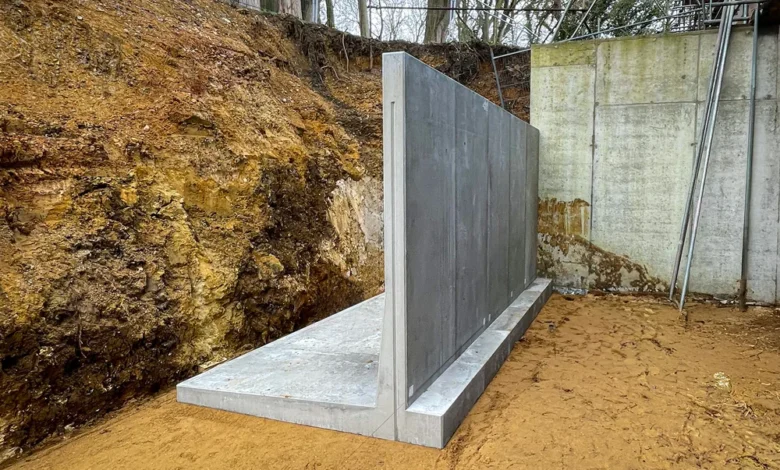
- Cantilever Retaining Walls: These are reinforced concrete walls shaped like an inverted “T”. Imagine a vertical stem (the wall) sitting on a horizontal base slab (the footing). The stem holds back the soil, while the base spreads out under the backfill to resist the overturning pressure. The weight of the soil on the footing actually helps stabilize the wall. Cantilever walls are built with steel reinforcement in both the stem and the base. Tensar describes them as “built using reinforced concrete, with an L-shaped or inverted T-shaped foundation”. The big advantage of a cantilever wall is that it can support greater heights (often up to 5 m or more) without an excessively thick wall. It’s a material-efficient design – for a tall concrete wall, you don’t need it to be insanely thick, because the footing does a lot of the work. Engineers often choose a cantilever wall when the slope is moderate to steep or when heavy loads (such as a roadway) are behind the wall. These walls require more skilled construction (concrete pouring and rebar tying), but they give a sleek, vertical wall on the outside once built.
- Anchored/Sheet Pile Retaining Walls: In situations where space is limited or loads are extremely high, engineers use anchored or sheet-pile retaining walls. A sheet pile wall is a type of anchored wall. It consists of thin yet strong piles (steel, vinyl, or wood) driven deep into the ground in a row. These act like panels holding back soil. The main support comes not just from weight, but from the depth they penetrate and any anchor tie-backs. The London Snowplow blog notes that sheet pile walls use “thin walls of steel, vinyl, or wood driven deep into the soil,” which is ideal for soft soils or tight urban spaces. Anchored walls can include concrete walls with heavy cables or rods (anchors) drilled into the hillside behind the wall. These anchors clamp the wall to the soil. In practice, if you are near a waterfront or a deep excavation (like a subway), you’d see sheet piling or anchored wall systems. They’re a different animal from gravity walls: imagine welding steel H-piles or inserting a continuous metal sheet into the ground – that’s a sheet pile wall in action. In simple terms, an anchored wall is a concrete or sheet-metal wall that’s “tied back” with cables or piles to hold the earth in place.
Materials and Construction
What concrete is used for retaining walls?
Concrete retaining walls typically use standard normal-weight concrete mixes, much like you’d use for a foundation or sidewalk. Manufacturers and specs often require a compressive strength of around 20–30 MPa (approximately 3000–4500 psi). For example, an industry specification calls for retaining wall block units with a 28-day strength of at least 20.7 MPa (3000 psi). In practice, poured concrete walls often use a slightly stronger mix (e.g., 25–30 MPa) because they also carry the reinforcement. In cold climates, wall concrete is often treated with air-entraining additives to resist freeze-thaw damage. Essentially, you need a robust, heavy mix that will last decades. Any concrete that meets local structural-code requirements (e.g., ASTM or Eurocode standards) can be used; however, engineers may specify additional measures, such as corrosion-resistant rebar or water reducers.
Precast segmental blocks (like those DIY-friendly retaining blocks) are also made from precast concrete – again with similar strength. The ARCAT specifications note that precast wall units must have a minimum 3000 psi compressive strength and low water absorption (for freeze resistance). In short, whether cast-in-place or precast, the concrete for retaining walls is a typical structural concrete designed to be freeze-thaw durable and strong enough to bear the lateral pressures.
It’s important to reinforce concrete walls with steel reinforcement bars (tension reinforcement) to prevent cracking under bending. Most poured concrete walls are also built with a continuous footing, as in cantilever walls, where the base “lever” does much of the work. In block-wall systems, each block is heavy and interlocks, and sometimes geotextile (geogrid) is laid in the backfill to tie it all together. Modern designs may also incorporate fiber-reinforced concrete (adding fibers) or post-tensioned anchors, but the base material remains a strong structural concrete mix.
Drainage and Backfill
Proper drainage is crucial for any retaining wall. Water pressure behind a wall can be worse than soil pressure. That’s why retaining walls always include a drainage layer (gravel) and often perforated drains or weep holes at the wall base. These let groundwater escape rather than build pressure. As one landscaping guide emphasizes, built-in drainage solutions “ensure that water does not accumulate behind the wall”. In practice, after the wall footing is placed, contractors lay 6–12 inches of free-draining gravel directly behind the wall and install a PVC drain pipe along the footing. Every few meters, the wall may have small openings (weep holes) to let water trickle out. Without this, water saturation would push the wall outward.
The backfill soil should also be carefully selected. Coarse, granular material (gravel/sand) is ideal because it doesn’t hold water. Clay soils are bad behind walls because they expand and trap water. The ARCAT spec even details gradation: 100% passing 1″, 0–60% passing No.4, etc. In short, contractors often use well-graded “wall rock” with 6–38 mm particles to fill behind blocks. Each layer of soil is compacted as the wall rises. Good drainage practice is one of the design considerations engineers must plan from day one.
Reinforcement and Support
Most concrete retaining walls (except very short gravity walls) have reinforcement. Poured walls use steel rebar – typically a grid in the stem and base. Cantilever walls will have heavy bars at the heel and toe of the footing, and vertical bars in the stem. These steel bars handle the bending forces. Segmental block walls (which are like giant Lego) sometimes forgo steel but use geogrid layers in the backfill. Geogrids are heavy-duty plastic mesh sheets that tie the soil to the wall face and help the mass act as a single unit. As Allan Block’s manual notes, tieback or anchor-reinforced designs use devices like earth anchors and soil nails in the backfill to stabilize very tall walls.
Design Considerations
Soil Pressure and Stability
Any retaining wall must resist the lateral soil pressure. Remember: soil exerts greater force at greater depths. So walls are usually thicker (or angled) at the bottom. Gravity walls are often battered (sloped) back into the hill for extra stability, shifting the center of gravity away from the toe. Cantilever walls rely on the footing and sometimes a key into the soil to prevent sliding. Designers must account for the soil type (sand, clay, etc.) and any surcharge (extra load) behind the wall, such as parked cars or buildings.
Tensar’s guide explains that walls must be built to withstand lateral pressure beyond what the soil can naturally withstand. If a wall fails, it’s usually because of excessive sliding or overturning (often due to poor drainage or excessive height). For safety, building codes in many countries require a licensed engineer to review walls above certain heights. In practice, if you plan a wall over ~1 meter (3–4 ft) in height, you should likely involve an engineer to sign off on it.
Drainage and Water Control
As mentioned, drainage is a critical design issue. Walls often include:
- A layer of perforated pipe at the base of the wall (inside the gravel) to carry water to daylight.
- Weep holes or open joints that allow water to escape behind the wall.
- Proper grading so surface water doesn’t pool behind the wall.
Without these, water pressure can crack or bow a wall. As one expert says, regular maintenance of these drainage features is key to longevity. Be sure the design calls for them – in fact, engineering codes often mandate drainage in retaining structures.
Slope and Site Conditions
Retaining wall design must adapt to site conditions. If the soil above the wall slopes toward it, the wall must fight a sliding force. In very steep areas, terracing (multiple shorter walls) can be more effective than a single large wall. Walls on rocky ground need different anchors than on soft fill. Construction difficulty is also a factor: cast-in-place walls require heavy equipment, whereas precast blocks can be assembled by hand. Environmental factors (like earthquake zones) also influence design.
Professional manuals (such as the Allan Block best-practices guide) show that even small choices – wall batter angle, footing width, use of composite reinforcement – can significantly affect performance. In practice, expect an engineer to follow a national code (e.g., ACI 318 in the US, BS EN 1997 in the UK/EU) for factors of safety.
Benefits and Maintenance of Concrete Retaining Walls
Concrete retaining walls offer several advantages:
- Durability: When built properly, concrete walls are long-lasting. They don’t rot or decay like wood, and they can be stronger than stone (depending on construction). Many concrete walls are expected to last 50+ years with minimal upkeep. In fact, experts note that a well-built concrete wall can easily last 35–50 years or more. Some block walls (especially interlocking blocks) have been known to last for a century or more if well-maintained. Because the wall is one continuous structure, it can endure harsh weather, UV exposure, and even impacts better than weaker materials.
- Strength-to-Height Ratio: Concrete is ideal for high walls. A tall concrete cantilever wall can withstand a much steeper slope than a typical masonry or timber wall of the same thickness. That makes it the go-to choice for highway overpasses, deep cuttings, or hillside developments.
- Versatility: Concrete can be molded into many shapes. You can get smooth, poured walls or textured precast blocks that look like stone or wood. Modern form liners and staining can make a concrete wall aesthetically pleasing. Concrete walls also allow precise engineering – the height, thickness, and reinforcement can be customized exactly for the project.
- Low Maintenance: Compared to wood, concrete walls require very little maintenance. There’s no painting needed, and pests won’t eat concrete. Periodic checks for cracks or drainage blockages are wise, but otherwise, a well-built concrete wall is often “set and forget.” The main upkeep is keeping the weep holes clear and repairing any cracks caused by settling or ground movement.
Maintenance tips: Even concrete walls need some care. Check the wall for any bulging or large cracks at least once a year. Make sure water drains – clear any debris from gravel/backfill, and ensure the pipes are open. Fix minor cracks with hydraulic cement or sealant to prevent water from seeping in. In cold climates, address freeze-thaw damage immediately (patch spalls, recoat surfaces). Regular inspection not only preserves appearance but also prevents a small issue from becoming a big failure.
Conclusion
A concrete wall retaining system is an engineering workhorse: it allows us to tame slopes, manage water, and expand usable land in hilly environments. We’ve seen that a retaining wall’s core function is to hold back soil and create stability. Concrete walls accomplish this with strength and durability. Whether built as a massive gravity barrier, a reinforced cantilever, or an anchored piling system, each design uses concrete’s properties to resist soil forces. Key design points include using strong concrete (typically ≥3000 psi), proper drainage to relieve water pressure, and sufficient reinforcement (steel or anchors) to ensure stability.
When done right, concrete retaining walls are cost-effective over the long term. They can last multiple generations and serve as permanent landscape features. Of course, quality construction and adherence to engineering standards are essential. For any major wall project, consult qualified engineers and local codes – this ensures the wall will be both safe and functional. If you follow best practices (correct concrete mix, drainage, backfill compaction, etc.), your concrete retaining wall will be a robust “shelf” that holds back the earth for decades, turning tricky slopes into stable, usable spaces.