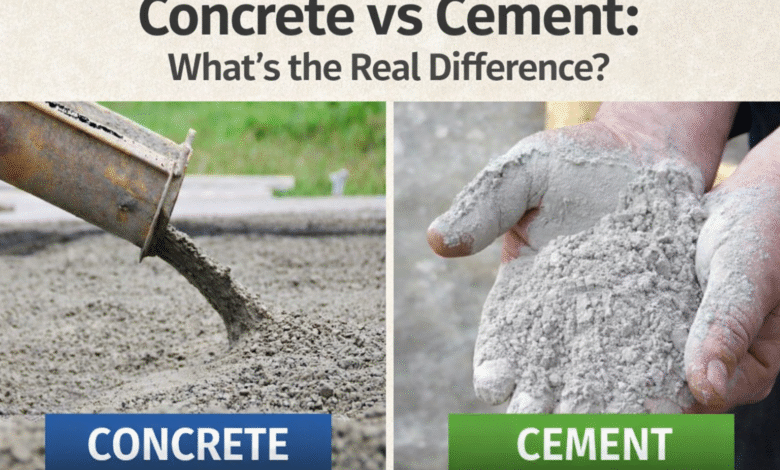
Understanding concrete vs cement is essential. Cement and concrete are two different things that people often mix up. Cement is a gray substance that firmly sets when water hits it. Concrete is the end product that is built after cement is mixed with sand, small rocks, and water. Think of cement as flour and concrete as bread. Just as flour separated from bread is still flour, so cement by itself cannot make anything strong.
Concrete vs Cement: Key Differences
When comparing concrete vs cement, the main difference is that cement is a binding material, while concrete is a complete construction material made using cement, sand, and aggregates.
What Is Cement?
Understanding concrete vs cement is important because many people confuse these two materials. Cement and concrete are two different things. Cement is a very fine powder that is mainly composed of rocks and clay. Workers heat limestone and clay in very hot ovens to make cement powder. Upon contact with water, cement becomes hard like a rock. However, all alone, it is very delicate. This might be the reason why builders, under no circumstances, welcome cement without the company of anything physical to the site.
Cement takes from 30 to 60 minutes till it starts to harden after you mix it with water. However, it becomes very hard within 1 to 2 hours. It continues to gain strength day after day and week after week. Most of the cement currently utilized is called by the name of Portland cement. It is gray and is very light in weight before the inclusion of water.
What Is Concrete?
Concrete is a stronger substance than cement as it contains both sand and rocks. To produce concrete, workers mix one part cement, two parts sand, and four parts small rocks. Also, they add enough water to make the mixture smooth. When the mixture dries, it becomes very hard and solid.
Concrete is capable of carrying very heavy things without throwing up. The material is used in houses, bridges, and roads, mainly for this reason. The very good concrete will be ten times stronger than pure paste. The stones and sand strengthen the concrete while the cement glues everything together.
Concrete has reached 70% of its full strength in about a week. After 28 days have passed, it gains its full strength. The construction workers can use the concrete after one day, but the heavy trucks should wait at least seven days to avoid fuel spills.
What Is Mortar?
Mortar is created with the help of a mixture of cement, sand, and water. Occasionally, they add some lime to make it more spreadable. Mortar is like concrete without the big rocks. That makes it a weaker material than concrete, but it is the best option through which the bricks are held together.
The mortar is mainly used in building walls from bricks or some stones. The mortar fills the space between bricks and holds them in place. Mortar is also used to plaster the walls with a finish that is called smooth.
A good mortar mix uses one part cement and three parts sand. Mortar is not as strong as concrete because it only contains sand and nothing else. Mortar is, however, a bit excessive, for it is sturdy enough to attach the bricks and blocks for many years.
What Is Asphalt?
Whereas cement and concrete belong to different materials, asphalt is known for being a material that is unique. Asphalt is derived from oil, which is subsequently combined with rocks and sand. It is heated and then poured out when it melts into roads. By the time it comes down, it will be a durable road, but it will still be a little supple.
A major part of the roads is made up of asphalt because it is affordable and is a quicker road to construct when compared to concrete. Asphalt roads, in particular, ensure a smooth and noiseless ride for cars. However, they are less sturdy than concrete and so undergo more repairs along the way.
Asphalt roads are projected to last for around 15 to 25 years, whereas the life of the concrete ones extends from 30 to 50 years. Asphalt has the capability to bend without cracking, which makes it a better material to use in cold weather as opposed to concrete, which has a tendency to crack in such weather. Normally, asphalt may become soft and produce rut of the heavy trucks during warm days with the temperature rising.
Key Differences Between These Materials
Strength
Concrete is the principal among all these materials in terms of strength. The capacity of concrete to support a great amount of weight without breaking is so incredible that it outperforms others. The only cement that is used by itself is fragile because it cracks quickly. Mortar does not have as much strength as concrete but it is durable. As far as asphalt is concerned, it is the most flexible material, but so far it has a low carrying capacity.
How Long Do They Last
Concrete is long-lasting. Bridges and roads made of concrete can last for 30 to 50 years with minor maintenance. Asphalt roads are designed to have a life period of about 15 to 25 years.
However, they are more frequently mended and surfaced. Mortar, when stored appropriately and not exposed to weather, can last for a long time. Cement itself is only used for temporary structures and resurfacing work.
Cost
Asphalt is the cheapest of all the surfaces at the time of installation. Concrete may seem more expensive at first, but it will save you more in the long term, so it is less expensive. Mortar is equal in price to concrete. Even though the price of cement powder per pound is higher, it is usually mixed with cheaper materials.
When to Use Each Material
Use Cement When:
Knowing when to use cement vs concrete helps in choosing the right construction material. To stick bricks together when laying the masonry walls
- To gain enough strength by adding water and firing to the concrete product to use in such cases, as the strength of it may be disrupted
- To fix small cracks or holes in concrete products
- The covering of interior walls with plaster is the best increasing them thermal protection
Use Concrete When:
To replace the ground leveling work with a house foundation job
- Concrete is utilized for the erection of floors and the casting of pavements
- Very strong walls and slabs are being placed
- They will be used for constructing bridges and other heavy buildings
Use Mortar When:
Constructing the brick walls or stone walls
- Installing the tiles on the walls or floors
- Providing the aesthetic part of the walls by smoothing plaster
The two blocks should be linked by the mortar used for that purpose (also called joint).
Use Asphalt When:
Challenging roads or expressways will be built. Concerning Resurfacing Driveways and constructing parking lots, asphalt is the most suitable. But it is also in front of other concrete materials.
Its flexibility makes it a perfect material for places where flexibility is essential and where budgets are tight, as flexural measures are the modestly featured aspect. The asphalt is the best and the cheapest choice for projects with a tight budget.
How These Materials Cure
Curing is a term that refers to the process of becoming hard and strong. Cement, concrete, and mortar are all cured in the same way. Curing is achieved by the chemical reactions that continue for weeks when the water mixes with the cement.
For proper curing, these materials must remain damp, or they will get weak and crack. The best curing takes at least 7 days of keeping the material moist.
Unlike the other materials, asphalt will harden as it cools down. It is the general practice to use the road in a few hours once the asphalt has cooled.
Important Tips for Using These Materials

Working with Concrete
Concrete cannot be stored when mixed for 90-120 minutes after mixing. After this time, concrete will be too hard to use in masonry work. Be sure to water the concrete and let it set for at least 7 days after pouring before walking on it.
Working with Mortar
If a large batch of the mortar gets stiff, throw it away and make a new one, as large portions will only get stiffer. Mortar dries up quicker than concrete, similar to the usage time of the mortar mix. As mortars become stiff when not in use, the cover has to be kept on when it is not being applied. Evenly apply mortar between layers of bricks, tiles, or stones.
Working with Asphalt
Asphalt has to be laid while it is hot. The workers must work and complete the road at a faster pace before it recovers its cooled shape. In order to smooth the asphalt out, roll it when it is still warm. To prolong the life of asphalt, it should be resealed every 3-6 years.
Simple Mixing Recipes
For a concrete mix, the following ingredients are required: 1 bucket of cement, 2 buckets of sand, and 4 buckets of gravel. Pour water slightly to achieve a less-sticky but still workable concrete mixture.
Mix ingredients together in a ratio of 1:3 cement to sand to make a mortar mix. Only add water enough to keep the mix consistent, as it can stand but not be able to run.
Getting these facts and procedures is the most common throughout house projects, although sometimes, for big bridges, builders use sophisticated equipment and precise measures.
Conclusion
In summary, understanding concrete vs cement helps you choose the right material for construction projects. Concrete is a strong material employed for large structures. On the other hand, mortar works as an adhesive for the bricks and stones. Asphalt provides the road surface with a comfortable, elastic layer that does not crack.
Every construction material has its own place in building, and factors like the right material in the right place of the house will make the structures strong, safe, and durable. Remember to do the mixing and cure the materials in the right way, so they look perfect all the time.